|
|
|
|
|
|
| |
|
|
Video tutorial for iZotope Ozone 3.0
This video tutorial has been acquired from Downloadtube.com
|
Review
This is official description
iZotope's complete mastering system in a single integrated plug-in includes eight essential mastering tools:
Maximizer, Equalizer, Multiband Dynamics, Multiband Stereo Imaging, Post Equalizer, Multiband Harmonic Exciter, Reverb, and Dithering.
Ozone 5's powerful new Meter Bridge provides a full suite of customizable audio analysis tools.
The following review written by one of the Software Informer contributors applies to version 3.0
The iZotope Ozone 3.0 program is a complete 64 bit analog modeled mastering suite of all the tools necessary to master commercial sound and produce higher quality audio.
Available for formats Pro Tools 6.4+ (RTAS Audio Suite/HTM), VST, MAS, Audio Unit, and DirectX, instead of a varied amount of plug-ins, users have the advantage of Ozone’s 7 plug-ins in one. Users can master tracks in for 16 bit CDs from a 24 bit source, by converting and dithering to 24, 20, 16, 12, or 8 bits. The Dither module features include a proprietary MBIT and noise-shaped dither, and peak limiting and harmonic suspension. Ozone 3’s evolutionary MBIT+ dither algorithm reduces quantization distortion with minimal perceived noise, creating a smooth, quiet noise.
Practical Mast Modules full of features include Multiband Stereo Imaging enabling users to set widening and imaging. The Mastering Reverb module in this program is a high quality 64 bit module that is designed to add an even more professional element to final mixes by allowing users to use reverbs on individual tracks to give a sense of space. This module also features options for mono, phase flip and channel reverse. For tone balancing, Ozone 3 includes an analog modeled Paragraphic Equiliser module with 8 fully adjustable filter nodes for tone balance. Another important feature of this software is its Multiband Harmonic exciter which has been modeled on analog tube saturation providing a more natural sounding excitation. A Mastering Guide is provided as well as Video tutorials. |
- Unlimited undo with history list.
|
- Slightly expensive for young producers.
|
|
Reviewed by: Nelson Sanchez Reviewer rating: Reviewed: 3 years ago
|
What's new in version 5.0
EQUALIZER
Analog-matched frequency response for all filter types
Vintage Low and High Shelf filters with variable "Cut" control
Extra-steep "brickwall" analog Low- and High-Pass filters
Flat Low- and High-Pass filters with variable slope
New Snapshots panel with easier EQ snapshot workflow
Improved, simplified Matching EQ feature
Mini Info Panel for easy access to active EQ band's settings
Ability to zoom by time and frequency for precise equalization
Separate EQ settings for left/right channels
Second Post EQ in signal chain for post-dynamics/exciter shaping
Zoomable spectrum in EQ
New Spectrum options including Left/Right and Mid/Side modes
Phase Response, Phase Delay and Group Delay plots
MAXIMIZER
IRC III Limiting mode: new psychoacoustic algorithm with transient preservation
Gain Reduction Trace view: shows gain reduction over time
Spectrum view
Stereo Link: allows variance between fully independent left/right limiting and linked limiting
DITHER
Additional Dither noise-shaping curves
Dither Shape view
EXCITER
Improved sound quality in all Exciter modes
Natural-sounding Peak Saturation: adds harmonics without drastic gain changes
Post-Saturation High Shelf filter: for additional harmonic shaping
Saturation Spectrum display: shows excitation by frequency
Refined Tube, Tape, Retro, and Warm algorithms
Oversampling mode prevents aliasing
STEREO IMAGING
New Vectorscope modes: Polar Level, Polar Sample
Anti-phase prevention
Stereo Width Spectrum view
Correlation Trace view shows mono-compatibility over time
Stereo Balance meter
Phase Rotation allows phase fine-tuning to optimize asymmetrical waveforms' loudness
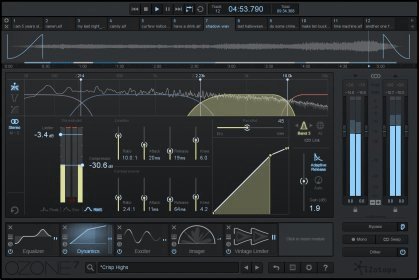
DYNAMICS
Greatly-improved workflow includes always-visible Attack and Release controls
All Bands mode shows most crucial controls for every band in one view
Gain Reduction Trace shows dynamics characteristics superimposed on waveform
Interactive Threshold provides intuitive control over all dynamics stages
Improved Gain Reduction meter with input/output and overlaid histogram options
Hard/Soft Knee selection
New upward compression boosts levels as they fall below the threshold
Limiter Boost pushes up threshold-crossing levels when Limiter ratio is set to the left
REVERB
New Modeled Reverb algorithm: provides realistic early reflections with smooth decay
Improved Plate and Room modes and new Hall mode
PRESETS AND ROUTING
All Global Presets updated to take advantage of new DSP and features
Many new genre-specific presets added to Global Presets
Improved Amount controls make adjusting presets simple
Module Presets: each mastering module has dedicated preset saving and loading
Over 80 new Module Presets included
Select independent or shared crossovers for multiband modules |
|
Report a wrong version
Report a wrong program title
Suggest a correction
|
Screenshots
All 8 screenshots |
|
|